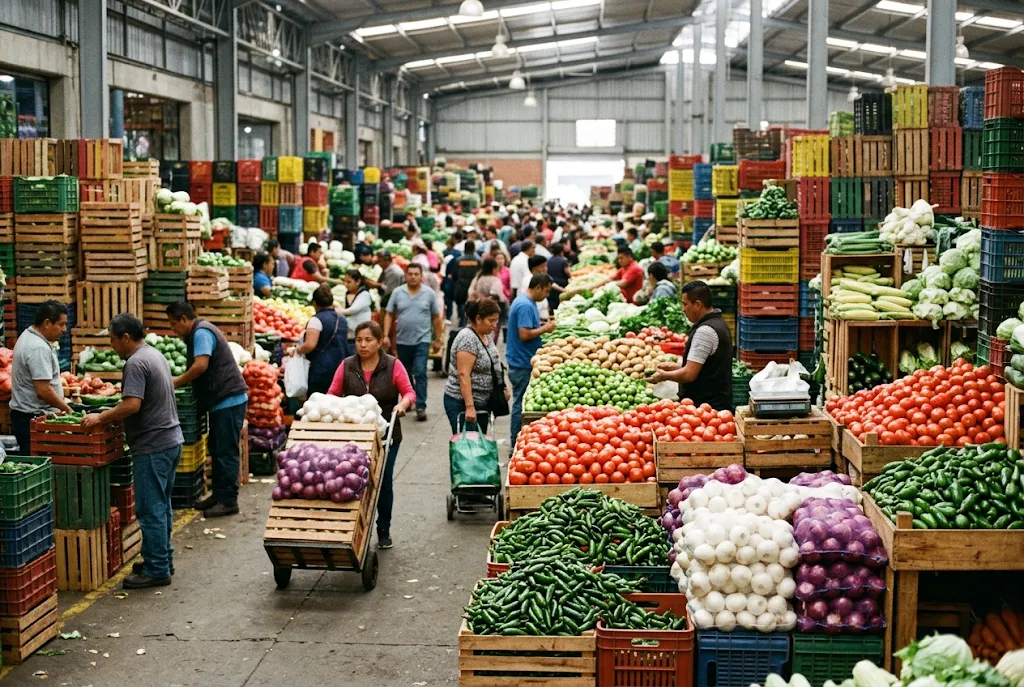
If you’re looking up Despensas Central de Abastos, you want one straight answer: what does a week’s worth of groceries cost right now at Mexico’s wholesale markets? As of the most recent Profeco monitoring in late 2025, the 24-product basic basket at the Central de Abasto in Iztapalapa, Mexico City, has generally landed in the low-to-mid 800-peso range — roughly 810 to 835 pesos (about US$44–46, depending on the exchange rate). That’s usually among the cheapest in the capital, and it sits under the federal reference cap of 910 pesos for those same products.
Here’s the catch, and it matters: that figure changes every week. A number you read today can be off by 30 or 40 pesos a few days later, because produce prices swing with the season and the harvest. So treat any single price as a reference point, not a fixed quote — and I’ll show you exactly where to check the live number before you shop.
What the “basic basket” actually means
When people talk about the canasta básica that Profeco tracks, they mean a specific list of 24 everyday products, not an open-ended cart. The list is calculated to feed a household of four for about a week.
It covers the staples you’d expect: things like eggs, chicken, beans, rice, tortillas, milk, cooking oil, pasta, sugar, tomato, onion, potato, lemon, apple, carrot, plus a few household items such as toilet paper. The idea is a consistent “apples to apples” bundle so prices can be compared fairly across stores and markets.
The Mexican government set a voluntary target with major retail chains to keep this 24-product bundle under 910 pesos. That cap is the benchmark most news reports measure against, and the national average has hovered around 844 pesos in recent monitoring — so most of the country sits below the ceiling, with real differences depending on where you shop.
Despensas Central de Abastos: today’s basic basket price explained
So why does the Central de Abasto keep showing up as the cheap option? Because it’s a wholesale market first and a shopping destination second. The CEDA in Iztapalapa is the largest wholesale food market in Latin America, and it’s where a huge share of Mexico City’s produce passes through before it reaches smaller shops. Fewer middlemen usually means lower shelf prices.
In practical terms, recent Profeco checks have repeatedly flagged the Central de Abasto as the most economical place in CDMX for the basic basket, with readings often in the 810–835 peso band through 2025. In some weeks it slipped behind chains like Chedraui or La Comer, then climbed back to the top spot — so it’s not permanently number one, just consistently competitive.
One honest point of context: the single cheapest basic basket in the whole country isn’t always at a Central de Abasto. In several monitoring rounds, a specific Bodega Aurrerá, Soriana, or Chedraui in cities like Mérida, Saltillo, or Campeche came in lower, sometimes in the 730–790 peso range. The Central de Abasto is a strong bet, not a guaranteed national low.
Why the number keeps moving
Three things push the price up and down week to week:
- Season and harvest. Produce like tomato, lemon, and chile can double or halve in price within weeks depending on supply. A single item spiking can move the whole basket.
- Weather and transport. Floods, fuel costs, and road conditions all feed into what sellers charge that morning.
- Where exactly you buy. Even inside the market, two sellers a few aisles apart can quote different prices for the same product.
That volatility is the main reason no one — including Profeco — publishes a price that stays true for long. It’s a snapshot, not a sticker.
How pricing actually works inside the market
This is the part first-timers get wrong, and it can quietly wreck the “cheap basket” math.
The Central de Abasto is built for mayoreo (wholesale) and medio mayoreo (half-wholesale). The headline low prices usually apply only when you buy in bulk — commonly around 2 to 4 kilograms of a product at a time. Walk up wanting a single tomato or half a kilo of onion, and you may not get the wholesale rate at all.
If you want smaller, retail-style quantities (menudeo), aim for the aisles set up for it. In the CDMX market, the I–J corridor is widely known as the area geared toward smaller purchases, which makes assembling a personal basket far more realistic than wandering the bulk warehouses.
A quick way to picture the trade-off:
| How you buy | Typical quantity | Price you’ll get | Best for |
|---|---|---|---|
| Mayoreo (wholesale) | Bulk, full crates | Lowest per kilo | Resellers, big families, shared buys |
| Medio mayoreo | 2–4 kg per item | Near-wholesale | Weekly family shopping |
| Menudeo (retail) | 1 kg or less | Higher, closer to shop prices | Small households, single items |
So the real saving comes from buying weekly quantities, not from buying the way you would at a corner store.
A rough price comparison
To give you a feel for the gap, here’s an illustrative comparison based on recent Profeco-style monitoring of the 24-product basket. These are reference figures, not live quotes — verify before you rely on them.
| Where | Approx. basic basket price (MXN) | Notes |
|---|---|---|
| Central de Abasto, Iztapalapa | ~810–835 | Often the cheapest in CDMX; needs bulk buying |
| Mega Soriana / Bodega Aurrerá (select stores) | ~750–830 | Some branches undercut the market in given weeks |
| Walmart / larger supermarkets | ~900–1,000 | Convenient, usually pricier on the same list |
| 910-peso federal cap | 910 | The benchmark, not a store price |
The takeaway isn’t “the market always wins.” It’s that a wholesale market and a specific discount-chain branch tend to trade places at the bottom, while big-box convenience usually costs more for the identical products.
How to check today’s real price before you go
Since the number shifts, the smart move is to pull the current figure yourself. A few reliable, free sources:
- Profeco’s price tool. The Quién es Quién en los Precios platform (a Mexican government consumer-protection tool) lets you compare current prices for staple products across stores and locations.
- Profeco’s weekly reports. The agency’s main site, Profeco, publishes regular updates on the basic basket, including which stores came in cheapest that week.
- Mexico City’s economic office. SEDECO CDMX tracks daily basic-basket prices for the capital, which is handy if you specifically plan to shop at the CEDA.
Check one of these the morning you plan to shop. Produce prices move fast enough that a Monday figure can be stale by Thursday.
Getting the most out of a trip to the market
If you decide the savings are worth it, a little planning goes a long way:
- Go early. The market runs around the clock, but the busiest supply hours are the early morning, when stock is freshest and sellers are most active.
- Bring cash and your own bags or a cart. It’s a working market, not a polished supermarket.
- Buy weekly quantities. That’s how you actually hit the wholesale and half-wholesale prices.
- Compare a couple of sellers. Prices vary aisle to aisle; a two-minute walk can save real money.
- Factor in transport. If getting there and back costs more than you save, a nearby discount store might be the smarter call. This is especially true if you’re buying a small basket.
For people who can’t make the trip, the market also runs an online ordering option, so bulk buying without the commute is possible in some cases.
The bottom line
A week’s basic basket at the Central de Abasto has recently run in the low-to-mid 800s of pesos, usually making it one of the cheapest spots in Mexico City — but the exact figure changes weekly, and a well-chosen discount-store branch can occasionally beat it. The honest answer to “today’s price” is: close to the range above, confirmed against a live source on the day you shop.
If saving on groceries is the goal, pair the market with a quick price check and buy in weekly quantities. That combination, far more than any single posted number, is what actually brings the cost down.