If you’ve been looking at tokens on Robinhood Chain, you’ve probably seen “liquidity locked” next to a Pons launch. You may have wondered what that means for your money.
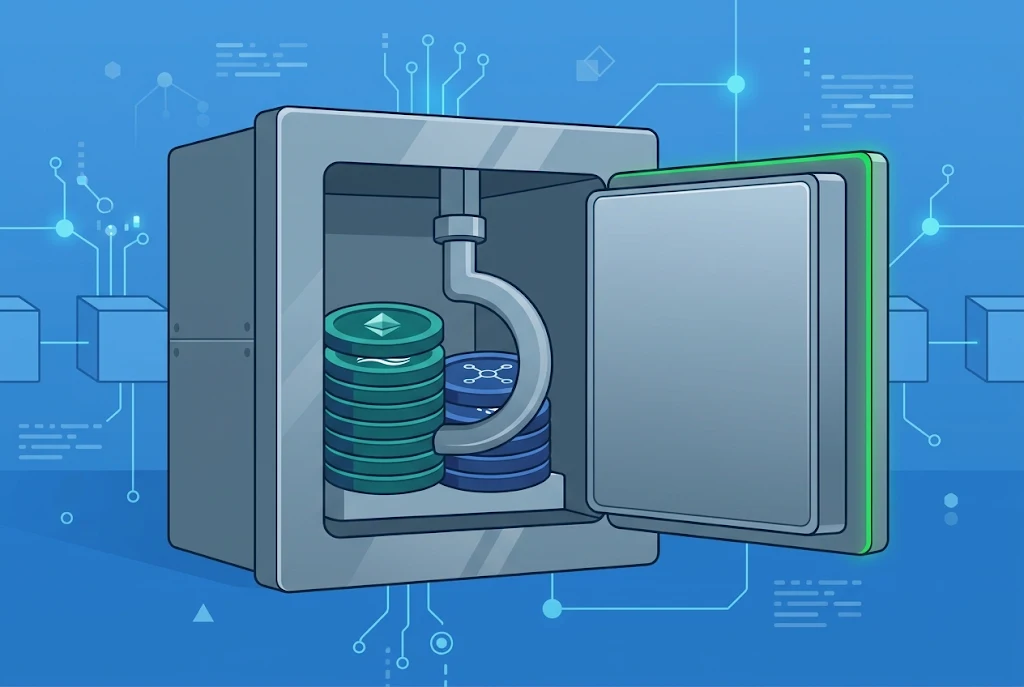
Here’s the short answer. The Ponslauncher locker is a smart contract that permanently holds the liquidity pool position of every Pons token that “graduates” from its bonding curve. Once a token’s Uniswap pool is created, the position goes straight into the locker. That contract has no withdrawal function. Nobody can pull the pool out, including the token’s creator and the Pons team.
That’s a real protection, but it isn’t a safety guarantee. The lock covers one specific risk: the pool vanishing in a single transaction. It doesn’t cover creator taxes, early insider buys, or large holders selling.
This guide explains how the lock works, how the older V1 and newer V2 lockers differ, and how to check a token’s lock yourself before you trade.
What Is the Ponslauncher Locker?
Pons (also searched as “Ponslauncher” or “Pons Launcher”) is a token launchpad on Robinhood Chain. Robinhood Chain is Robinhood’s Ethereum layer 2 network, and its public mainnet went live on July 1, 2026. Pons works a lot like pump.fun on Solana: anyone can create a fixed-supply token in minutes without writing code.
The locker is the part of Pons that handles liquidity after launch. A few terms will make the rest of this guide easier to follow:
- Bonding curve: A contract that sets a token’s price by formula. Every buy raises the price and every sell lowers it. New V2 tokens trade here first.
- Graduation: The moment a token leaves the curve and gets a real Uniswap pool.
- Liquidity position: The pool’s paired assets (for example, ETH plus the token), represented on-chain as a position.
- Locker: The contract that receives and holds that position.
In plain terms, the locker is a vault with a deposit slot and no door.
How Pons Locks Liquidity, Step by Step
The process happens automatically. Neither the creator nor the buyer has to do anything to trigger it.
Before Graduation: There’s No Pool to Lock Yet
When a V2 token launches, the factory mints its entire fixed supply to the bonding curve, not to the creator. The creator gets no free allocation. If they want tokens, they buy them like everyone else.
During this stage, the ETH from buyers sits in the curve contract, and sellers sell back into it. No liquidity is locked yet, because no pool exists. Most tokens never leave this stage. ChainSift counted about 1,070 Pons launches over five and a half hours on October 2, 2026, and only 13 of them reached a pool in that window.
Graduation: The Pool Is Created and Sent to the Locker
When the curve collects enough, the token graduates. ChainSift puts the threshold at about 4.2 ETH for ETH-paired launches; stock-paired launches measure graduation in their pairing asset. At that point the factory:
- Takes the ETH (or other pairing asset) collected by the curve
- Combines it with the remaining tokens
- Creates a Uniswap pool run through Pons’s own hook contract
- Mints one full-range liquidity position directly to the Ponslauncher locker
Because the position is minted straight to the locker, it never passes through a wallet anyone controls. The lock happens in the same step that creates the pool.
The Extra Locked Supply
Some tokens can’t go into the pool without pushing its opening price down. According to ChainSift’s review of the contracts, about 8% of the supply ends up locked in the same locker permanently, alongside the pool position.
That’s why a graduated Pons token usually shows two locks on-chain: the pool position and a plain token balance held by the locker.
Pons V1 vs V2 Lockers: What’s Different
Pons has run two versions of its contracts. V1 was used in the first weeks after launch. V2 has been used for every new launch since August 2026. Both lock liquidity, but they work a little differently.
| Feature | V1 Locker | V2 Locker |
|---|---|---|
| Pool type | Uniswap V3, paired with WETH | Uniswap V4, run through the Pons hook |
| Launch path | Directly into a locked pool | Bonding curve first, then locked pool |
| Can it remove liquidity? | No | No |
| Can it collect trading fees? | Yes, and it can change who receives the creator’s share | No; in V4, Pons’s hook takes its cut on each trade |
| Pairing options | WETH only | ETH, USDG, approved tokenized stocks, cbBTC |
| Locker address (verify before use) | 0x736d76699c26d0d966744cae304c000d471f7f35 | 0x267444d099b10fb5ed7c3cc7b7c767adca574952 |
A common mix-up: Uniswap V3’s position manager on Robinhood Chain (0x73991a25…) is not a Pons locker. It issues every V3 position NFT on the chain, Pons or not. Seeing it next to a pool tells you nothing about whether that pool is locked. What matters is who owns the position.
Is the Ponslauncher Lock Permanent?
For tokens that have reached a pool, yes. Neither locker has an expiry date or a withdrawal function, and ChainSift found that neither contract is an upgradeable proxy. The Pons team can’t swap in new code later to release positions.
Some older articles describe the Pons lock as a time-based LP lock that expires after a set period. That doesn’t match what the current contracts show. If you read that claim, check the date on the article and verify the locker yourself on the block explorer.
There’s one edge case worth knowing. If a token’s curve closes but its pool can’t be created for seven days, the Pons owner (a multisig wallet) can move that launch’s ETH and tokens elsewhere. Anyone can end that window by creating the pool. The power also can’t touch a pool that already exists.
What the Pons Lock Doesn’t Protect You From
This is where many new traders get caught out. A locked pool stops a classic “rug pull,” where a creator removes all the liquidity at once. It doesn’t make a token safe or valuable.
Here’s what the lock leaves uncovered:
- Creator tax. Creators can set a tax of up to 10% on every buy and sell, paid to them. It’s charged through Pons’s hook, not the token contract. ChainSift reported that 29 of 40 recent launches it checked had one, mostly 1.5% to 3%.
- The standard Pons fee. Every trade also pays a 1% Pons fee. Of that fee, 70% goes to the creator’s side and 30% to the protocol.
- Anti-bot exemptions. In the first few seconds, buyers pay a very high anti-snipe tax (up to 99%) that falls to zero quickly. Creators can exempt chosen wallets from it. Those wallets can buy at the starting price and sell minutes later.
- Large holders selling. Anyone who bought cheaply on the curve can sell into the locked pool at any time. The pool can’t disappear, but it can be drained by sells.
- No demand. A permanent pool can still go quiet. Trading in most launchpad tokens fades within days.
The lock answers one question: “Can the pool be pulled?” It doesn’t answer “Is this token a good buy?”
Why Token Scanners Sometimes Get Pons Tokens Wrong
You might paste a Pons token into a popular safety scanner and see “0% tax” or “liquidity not locked.” Usually that’s a reading error, not a red flag.
There are two reasons:
- Tax lives in the hook, not the token. Scanners read taxes from the token contract. Pons tokens are plain ERC-20s with no tax code, so the creator tax charged in the pool doesn’t show up.
- Pons lockers aren’t on scanner lists. Most scanners recognize a fixed set of well-known lockers from other chains. The Ponslauncher locker often isn’t on those lists, and some scanners don’t detect Uniswap V4 pools at all.
So a scanner can make a Pons token look safer than it is (missing the tax) and riskier than it is (missing the lock) at the same time.
How to Check a Ponslauncher Lock Yourself
You don’t need special tools. Robinhood Chain’s public block explorer is enough. These steps follow the read functions documented by ChainSift; contract details can change, so confirm against the official Pons V2 documentation first.
- Confirm it’s a real Pons token. Open the Robinhood Chain block explorer, find the Pons V2 factory, go to “Read contract,” and use
getLaunchedTokenwith the token address. A genuine Pons token returnsexists: true. Token names and tickers aren’t unique, so the contract address is the only reliable ID. - Check the stage. In the same result, a
phasevalue of 0 means the token is still on the curve. A value of 2 means its pool exists and sits in the locker. - Read the creator tax. The
creatorTaxBpsfield shows the tax in basis points. A value of 200 means 2%. - Look for exempt wallets. Open the token’s curve address, go to Logs, and look for
SnipeTaxExemptedevents. Each one names a wallet that skipped the anti-bot tax. - Review the holders. On the token’s Holders tab, ignore Uniswap V4’s PoolManager and the Pons locker; those hold pool and locked tokens. Focus on the wallets that remain, especially any exempt wallets from step 4.
If you’d rather not read contracts directly, ChainSift offers a free checker that reads Pons’s factory and locker. Treat any third-party tool as a starting point, not a final verdict.
What This Looks Like in Practice
Here’s a made-up example to show how the pieces fit together.
Say a token called MAPLE graduates and shows “liquidity locked, permanent.” That part checks out. But step 3 shows a 3% creator tax, and step 4 shows two exempt wallets that bought in the first second.
That means every $100 trade pays $3 to the creator plus a $1 Pons fee. Those two wallets also hold cheap tokens they can sell at any time. The lock is real, but your actual risk depends on the tax, the exempt wallets, and how concentrated the holders are.
Final Thoughts
The Ponslauncher locker does one job well. Once a Pons token graduates, its liquidity pool is locked permanently, with no withdrawal path for the creator or the platform. That removes the most direct way to rug a token.
Everything else is still on you to check: the creator tax, the exempt wallets, the holder spread, and whether anyone is still trading.
Before buying any Pons token, take two minutes to run the checks above. Memecoins on any launchpad are high-risk, and many go to zero. This guide is for education only and isn’t financial advice. If you’re putting in money you can’t afford to lose, speak with a qualified financial professional first.
Frequently Asked Questions
Is Pons liquidity locked forever?
For graduated tokens, yes. Neither the V1 nor V2 locker has an expiry date or withdrawal function, and neither contract is upgradeable. Tokens still on the bonding curve don’t have a pool yet, so there’s nothing locked.
Can a Pons token creator still rug pull?
They can’t pull the pool. They can still profit by charging a creator tax of up to 10%, or by selling tokens bought through anti-bot-exempt wallets. Check both before trading.
Does the Ponslauncher lock cost creators extra?
No separate lock fee is documented. Locking happens automatically at graduation as part of the launch process. Launch and trading fees can change, so confirm current rates in the official Pons docs.
Why does my scanner say a Pons token isn’t locked?
Many scanners don’t recognize Pons’s locker contracts, and some can’t see Uniswap V4 pools. Verify the lock directly on the Robinhood Chain explorer instead.