If you’ve ever searched how to last long on bed, you’ve probably seen Kegel exercises mentioned in passing, usually as one bullet point in a long list. They deserve more attention than that. The muscles a Kegel trains are the same ones that tighten during ejaculation, and learning to control them is a real, research-supported skill.
The short answer: Kegels strengthen your pelvic floor muscles and, just as importantly, teach you to feel and control them. Do them daily for about 12 weeks, learn to relax those muscles as well as squeeze them, and pair the training with techniques like stop-start. Many men notice better control within a few weeks to a few months. Kegels aren’t a quick fix, though, and if early ejaculation is frequent and upsetting, a doctor visit is worth it.
Here’s how the training works, what the studies actually found, and a week-by-week plan you can follow.
What Your Pelvic Floor Has to Do With Ejaculation Control
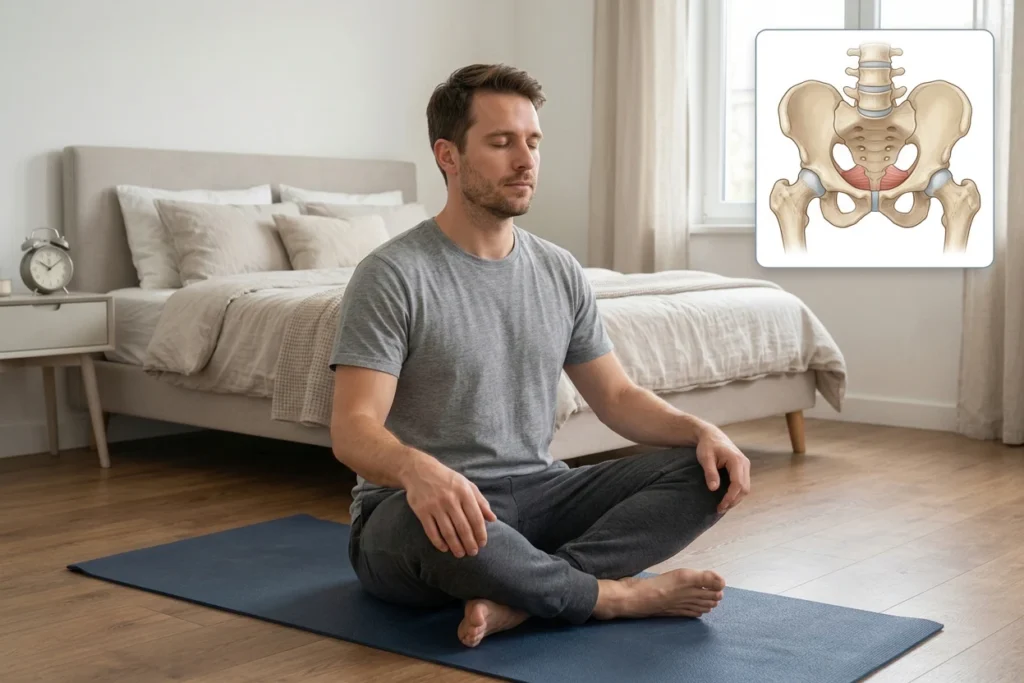
Your pelvic floor is a sling of muscle running from your pubic bone to your tailbone. It supports your bladder and bowel, and it plays a direct role in sexual function, including erection firmness and the rhythmic contractions of ejaculation.
Think of ejaculation as a reflex with a point of no return. Before that point, there’s a window where you can still slow things down. Men who struggle with timing often can’t feel that window clearly, or they can’t relax the muscles that push them past it.
Pelvic floor training works on both problems:
- Awareness: You learn exactly where these muscles are and what tension in them feels like.
- Control: Over time, you get better at holding, releasing, and calming them on purpose.
That second point is the one most articles miss. Strength helps, but control is the real goal.
What the Research Actually Shows
The best-known work here comes from a team at Sapienza University of Rome. Their numbers are encouraging, but the details matter, because the study setup was very different from doing Kegels on your couch.
In a 2014 study, the researchers treated 40 men aged 19 to 46 who had lifelong premature ejaculation. After a 12-week program, 33 of the 40 men gained control of their ejaculatory reflex. Average time to ejaculation rose from 31.7 seconds to about 146 seconds.
A 2018 follow-up from the same group looked at long-term results. Of the 95 men who completed 36 months of follow-up, 64% still had satisfactory control at 24 months and 56% at 36 months. So benefits faded for some men, which suggests the exercises work best when they become a lasting habit.
Now the important caveats:
- These programs ran in a clinic, three sessions a week, and included biofeedback and mild electrical muscle stimulation, not just home Kegels.
- The studies didn’t compare against a group that received no treatment, so some of the improvement could come from other factors.
- A 2015 systematic review of behavioral therapies found only limited evidence overall, though it noted that combining behavioral methods with medication tended to beat medication alone.
Home Kegels vs. Clinical Pelvic Floor Therapy
| Home Kegel routine | Supervised pelvic floor therapy | |
|---|---|---|
| Cost | Free | Varies by clinic and insurance |
| Feedback on technique | Self-check only | Therapist plus biofeedback tools |
| Evidence base | Indirect, based on clinic studies | Small studies with promising results |
| Best for | Mild timing concerns, motivated self-starters | Lifelong or long-standing issues, men unsure they’re doing it right |
The honest takeaway: home Kegels are a sensible, low-risk starting point. If they don’t help after a few months, a pelvic floor physical therapist can offer the guided version that was actually studied.
How to Find the Right Muscles First
This step decides whether the rest of the plan works. Mayo Clinic physical therapists estimate that about 40% of people don’t perform a Kegel correctly on the first try.
Try one of these to locate the muscles:
- The gas test: Tighten the muscles you’d use to stop yourself from passing gas. You should feel a lift and squeeze around the base of the pelvis.
- The midstream test: Next time you urinate, briefly slow or stop the flow. Do this once or twice to learn the feeling, not as a regular exercise, since repeatedly stopping urine can interfere with normal bladder emptying.
- The mirror check: Stand without clothes in front of a mirror and contract. If you’re using the right muscles, the base of the penis should draw in slightly and the testicles should lift.
What you shouldn’t feel is your stomach, buttocks, or thighs doing the work. If they tense up, you’re compensating. Breathe normally the whole time; holding your breath is a sign you’re bracing with the wrong muscles.
A 12-Week Kegel Plan for Lasting Longer in Bed
This plan builds on Mayo Clinic’s Kegel guidance for men, which recommends short holds, rest periods of equal length, and three sets a day. The later phases add the control work that matters for timing.
Weeks 1–2: Learn the Basic Squeeze
- Lie on your back with knees bent. This is the easiest position for beginners.
- Squeeze for 3 seconds, then fully relax for 3 seconds.
- Do 10 repetitions per set, three sets a day.
Focus on the release as much as the squeeze. Each rep should end with the muscles completely soft.
Weeks 3–6: Build Endurance and Speed
- Gradually extend holds to 5, then up to 10 seconds, with equal rest.
- Add “quick flicks”: 10 fast squeeze-and-release pulses after each set.
- Move one set to sitting and one to standing.
Tie sets to things you already do every day, like brushing your teeth or waiting for coffee. Men who link Kegels to an existing routine are far more likely to stick with them.
Weeks 7–12: Practice Control Under Arousal
This is where strength turns into timing. During solo practice, notice the moment arousal starts to climb steeply. Instead of tensing up, do the opposite: take a slow breath and consciously relax your pelvic floor. If you’re very close, pause stimulation entirely until the urge drops.
You’re training your body to stay below the point of no return. It feels awkward at first, which is normal. After several weeks, most men find they can sense that threshold much earlier.
How to Track Your Progress
Progress here is easy to miss because it’s gradual, so a simple log helps. Once a week, jot down three things:
- Longest comfortable hold: How many seconds can you squeeze without your stomach or glutes joining in?
- Release quality: Do the muscles fully let go after each rep, or does some tension linger?
- Awareness during arousal: On a 1 to 5 scale, how clearly could you feel the build-up before the point of no return?
If your hold time climbs but your awareness score stays flat, spend more time on the week 7–12 practice and less on hard squeezes. If nothing at all has changed by week 8, that’s a good reason to have a professional check your technique rather than just doing more reps.
The Part Most Guides Skip: Relaxing the Pelvic Floor
Plenty of men assume a stronger pelvic floor is always better. It isn’t quite that simple.
Some men carry constant tension in these muscles, often linked to stress or anxiety. A tight pelvic floor that never fully lets go can make arousal feel rushed and harder to manage. Adding hundreds of hard squeezes to already-tense muscles won’t help.
Signs your pelvic floor might be tight rather than weak:
- Pelvic, perineal, or tailbone discomfort
- Trouble starting urination or a weak stream
- Feeling like you can’t fully “let go” after a squeeze
If any of these sound familiar, see a doctor or pelvic floor physical therapist before you start a strengthening routine. They may suggest relaxation-focused exercises, often called reverse Kegels, before any strength work.
Common Mistakes That Stall Progress
- Overtraining: More isn’t better. Hundreds of reps a day can tire the muscles and make control worse.
- Skipping the relax phase: Half-releasing between reps trains tension, not control.
- Quitting at week three: Muscle changes take weeks to months. Early sessions mostly build awareness.
- Squeezing during sex as a panic move: Hard clenching right at the edge often speeds things up. Relaxing works better.
- Expecting Kegels to fix everything: If anxiety, relationship stress, or erection problems are involved, Kegels alone won’t cover it.
How to Last Long on Bed Naturally: Pair Kegels With These Habits
Pelvic floor training works best as one part of a broader approach:
- Stop-start technique: Pausing stimulation before the point of no return, then resuming, builds the same awareness Kegels develop. Using the two together makes sense.
- Slower breathing: Shallow, fast breathing tends to rise with arousal. Deliberately slowing it can calm the whole system.
- Talking with your partner: Pausing is much easier when your partner knows why you’re doing it. Most partners respond far better to openness than to silent frustration.
- Managing performance pressure: Worry about lasting long enough can itself shorten the experience, which turns into a frustrating cycle.
When to See a Doctor
Early ejaculation now and then is common and usually not a medical issue. The International Society for Sexual Medicine describes clinical premature ejaculation as ejaculation that consistently happens within about one minute of penetration (lifelong) or a bothersome drop to about three minutes or less (acquired), along with distress or avoidance of intimacy.
Book an appointment with your doctor or a urologist if:
- The problem happens most of the time and has for months
- It started suddenly after years of no issues
- You also have erection problems, pain, or urinary symptoms
- It’s causing real stress in you or your relationship
A new problem is especially worth checking, because conditions such as prostate inflammation or thyroid issues can sometimes play a role. Treatment options include behavioral therapy, sex therapy, topical products, and prescription medication, and a doctor can help you weigh them. Kegels can usually continue alongside any of these.
The Bottom Line
Kegel exercises are one of the few ways to last longer in bed that are free, private, and low-risk. The research behind them is small but promising, and its main lesson is that control, not just strength, makes the difference. Start with the basic squeeze, stay consistent for 12 weeks, practice relaxing at high arousal, and pair the training with stop-start. If you don’t see progress after a few months, a pelvic floor physical therapist or urologist can take it from there.
Frequently Asked Questions
How long do Kegels take to help with lasting longer?
Most men need consistent daily practice for a few weeks before noticing changes, and the clinic studies ran for 12 weeks. Better awareness often shows up before better timing.
Can Kegels make premature ejaculation worse?
They can if you already have a tight pelvic floor or if you overtrain. Signs include pelvic discomfort or trouble relaxing the muscles. In that case, check with a doctor or physical therapist before continuing.
Do I need any equipment for Kegel exercises?
No. Basic Kegels need nothing at all. Clinical programs sometimes use biofeedback devices, but those are best used under a therapist’s guidance.
Should I do Kegels during sex?
Not as hard squeezes at the last second. Relaxing your pelvic floor and slowing your breathing tends to help more than clenching when you’re close.
This article is for general information only and isn’t medical advice. Talk to a qualified healthcare professional about your specific situation.